The Real Cost of IT Downtime for Singapore SMEs (Do the Math in 5 Minutes)

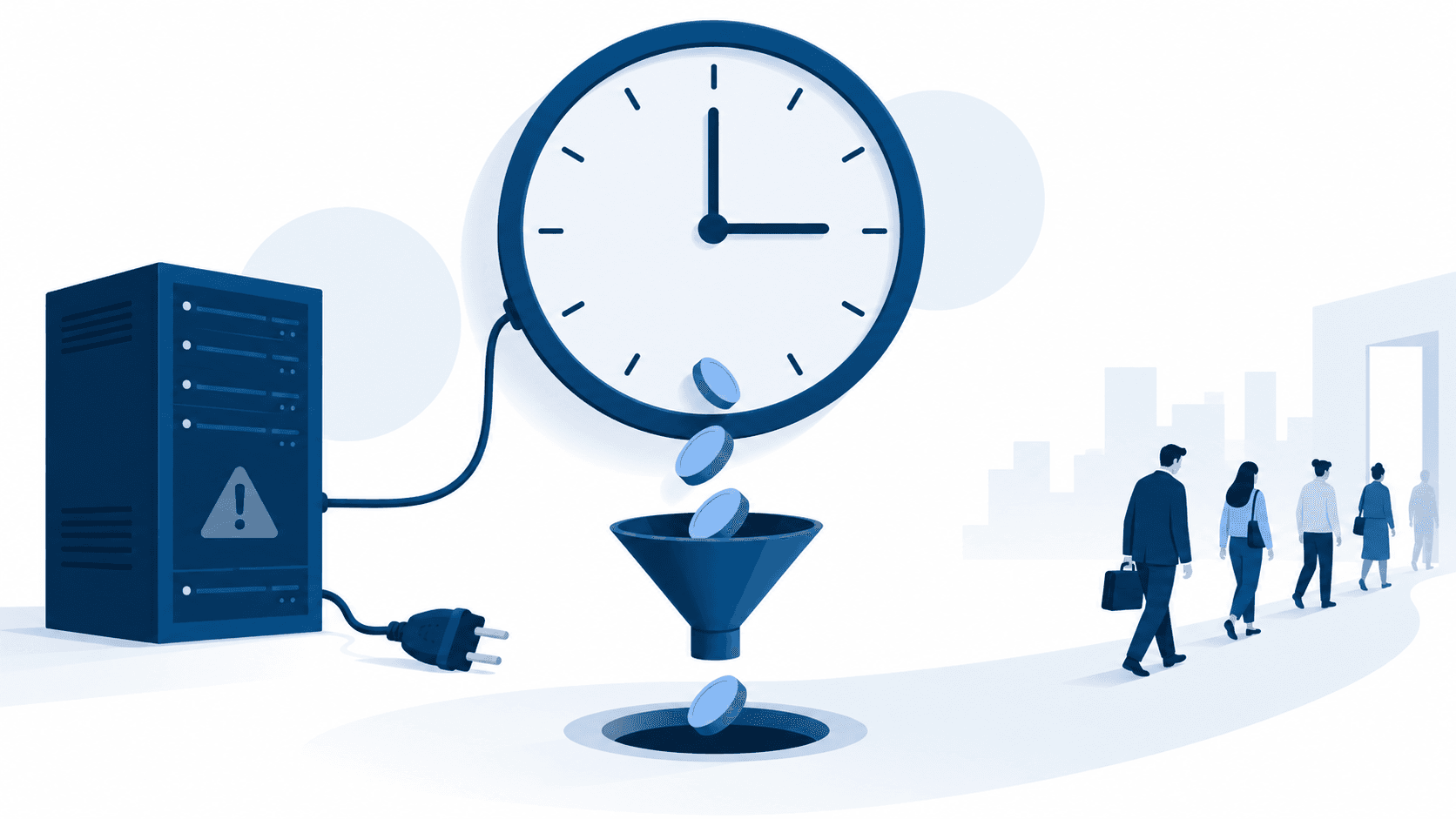
Industry surveys put the cost of IT downtime for small businesses anywhere between US$1,000 and US$25,000+ per hour — a range so wide it's useless for your budget meeting. The honest answer is that your number depends on your revenue, your headcount and how much of your work stops when systems stop. The good news: you can compute it on a napkin in five minutes. For a typical 30-person, S$3M-revenue services firm, the math below lands around S$1,700 per hour — before recovery costs. And the real danger isn't the hour: serious incidents are measured in days.
Why downtime feels free — until it isn't
When a shop's shutter jams, everyone sees the customers walk away. When a server dies, the walking-away is invisible: quotes don't go out, orders sit in carts, invoices don't get raised, and thirty people quietly switch to "waiting mode" on full salary. Because nobody sees the queue leaving, downtime rarely makes it into the budget — it just gets paid for later, in a lump.

The napkin math: your downtime cost per hour
Add three lines, then note a fourth you can't compute:
- Revenue you can't book. Annual revenue ÷ 2,000 working hours × the share of your revenue that needs systems to happen. If you can't quote, sell, bill or deliver without IT, that share is high.
- Payroll burning while people wait. Affected staff × loaded hourly wage × how much of their work actually stops. People don't go to zero — they go to 40–70% less.
- Recovery. Ad-hoc IT hours at S$120–250/hour, plus any work that has to be re-done because it lived on the thing that died.
- The multiplier you can't compute. Missed SLAs, penalty clauses, the client who quietly starts a second vendor search. This line has no formula — it just makes every number above bigger.
A worked example
A 30-person services firm doing S$3M a year, where roughly 70% of work needs systems: revenue line = S$3,000,000 ÷ 2,000 × 70% ≈ S$1,050/hour. Payroll line = 30 staff × ~S$35/hour loaded × 60% stopped ≈ S$630/hour. That's roughly S$1,700 per hour before a single recovery dollar — call it S$13,000–14,000 for one dead working day. Run your own numbers; the point isn't our example, it's that yours takes five minutes and ends the "is IT spending worth it" debate with arithmetic.
The hours aren't the danger. The days are.
A power blip costs you an afternoon. A ransomware incident costs you a calendar: average ransomware-related downtime ran around 24 days in 2025 surveys. The spread is what should interest you — about half of businesses now recover within a week, but only 16% manage it within a day. The difference between the one-day companies and the three-week companies isn't luck. It's preparation: tested backups, a written response plan, and someone who has done this before.
Multiply your napkin number by a three-week outage and you'll understand why the Backup and Respond areas of the Cyber Essentials framework exist — they're the two that decide whether your bad day is a Tuesday or a quarter.
What actually shrinks the number
Two levers, and they work on different parts of the math:
- Fewer incidents (prevention). Monitoring that catches the failing disk before it fails, patching that closes the hole before it's used. This is the boring machinery inside a managed IT arrangement — it shrinks how often the meter starts running.
- Faster recovery (preparation). Tested restores and an agreed recovery time. In our price guide we noted that "we back up nightly" is cheap while "we can restore your operations within 4 hours" is not — your napkin number is how you decide whether the expensive version pays for itself. At S$1,700/hour, a service that turns a 3-day outage into a 4-hour one is worth about S$40,000 per incident.
Honest calibration: not every business needs the gold plan
A 5-person firm that can genuinely work off phones and hotspots for a day has a small napkin number — match the spending to it. A clinic that can't see patients, a logistics firm that can't dispatch, an agency on client deadlines: big number, spend accordingly. Downtime protection is insurance — you size it to the building, not to the salesman's enthusiasm.
Frequently asked questions
How much downtime is "normal" for an SME?
With proactive monitoring, unplanned downtime should be minutes per month, not hours. Most SMEs without monitoring lose several hours a month — they just never log it, so it never becomes a line item. Your staff know the real answer; ask them how often "the system is slow or down" costs them time.
We're fully on cloud — doesn't that mean no downtime?
It means less server downtime, not none — cloud services have outages too, and your office network, devices and accounts are usually the weaker link. Cloud moves the problem; it doesn't retire the napkin.
What's an RTO and why does it matter?
Recovery Time Objective — the agreed maximum time to get you running again. It's the single number that converts "we have backups" into a promise you can hold someone to. Ask your provider for it in writing; the reaction tells you a lot.
Are backups enough to keep us running?
Backups protect your data; they don't by themselves keep the business operating — restoring systems, access and workflows takes its own plan. Backup versus business continuity deserves its own article, and it's on our list.
Our approach
Everything in our managed IT model is aimed at the two levers above: monitoring and patching to make incidents rare, tested backups and an agreed RTO to make them short. The monthly fee is what "the meter never really starts" costs.
Done the napkin math and didn't like the number? Book a discovery call — bring your figure, and we'll show you exactly which parts of it a managed arrangement removes, at what cost, so you can compare like an accountant instead of guessing.

Steven Shi · Founder & Technical Director
Steven is the founder and Technical Director of Evernet Systems, a Singapore-headquartered managed services provider serving 70+ SMEs. He leads Evernet's transformation from traditional MSP to AI-powered infrastructure partner — automating 40% of the company's own operations before bringing the same playbook to clients. He writes about practical AI adoption, IT infrastructure and PDPA compliance for growing businesses.
Need help with this?
We help Singapore SMEs put these ideas into practice. Book a free 30-minute discovery call.
Book a CallRelated articles
Cyber Essentials Mark 2026: A Step-by-Step Guide for Singapore SMEs
Singapore's national baseline cybersecurity certification, explained for business owners: the five control areas in plain language, what it costs after CSA funding, and the step-by-step path — before the first-certification funding ends in February 2028.
Read Industry TipsPDPA Compliance for Singapore SMEs: What You Actually Need to Know
PDPA compliance doesn't have to be overwhelming. Here's a practical guide for SME owners who want to stay compliant without drowning in legalese.
Read