Cyber Essentials Mark 2026: A Step-by-Step Guide for Singapore SMEs

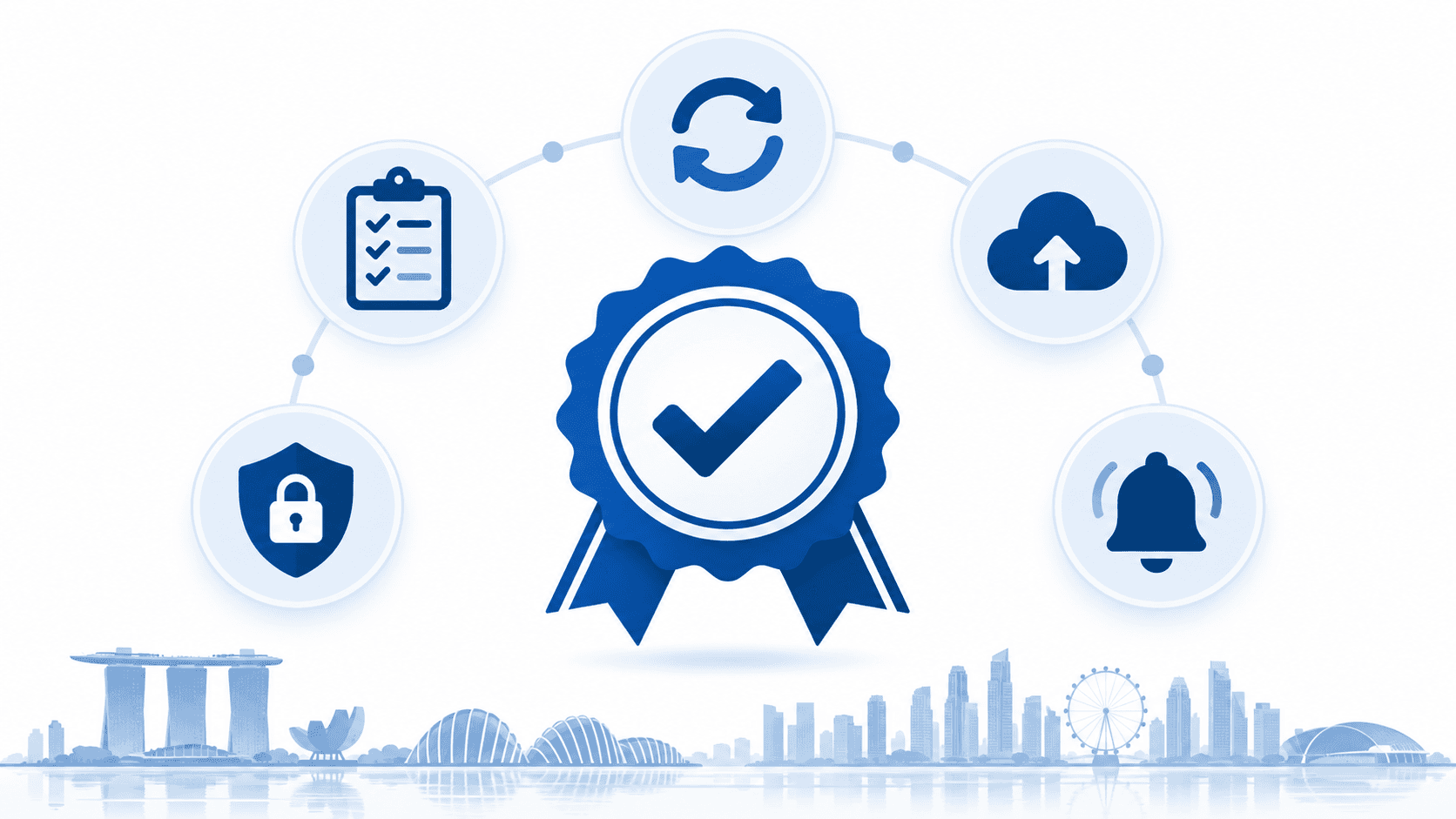
The Cyber Essentials mark is Singapore's national baseline cybersecurity certification for SMEs, run by the Cyber Security Agency (CSA). Think of it as bizSAFE for cybersecurity: a government-recognised badge that says your basics are in order. It's valid for two years, the requirements fit on one page (five areas: know your assets, protect them, update them, back them up, and have a response plan), and CSA currently deducts S$250–650 of the certification fee at source — but only for your first certification, and only until 6 February 2028. Here's the whole path, in plain language.
What it is — and what it's actually for
Most Singapore bosses know bizSAFE: nobody gets excited about it, but try bidding for certain contracts without it. The Cyber Essentials mark is heading the same way for cybersecurity. It isn't legally mandatory today — but larger customers increasingly ask for it in vendor assessments, insurers look at it when pricing cyber coverage, and the government has signalled that organisations handling sensitive data or bidding for public contracts may eventually need it. Getting certified while it's optional (and funded) beats scrambling when a tender suddenly requires it.
There's a quieter benefit too: the PDPA requires "reasonable security" for personal data, and a current Cyber Essentials certificate is about the cleanest evidence an SME can produce that its security effort is real. (If PDPA is new territory, start with our plain-language PDPA guide.)
The five control areas, in shop terms
CSA's framework groups the requirements into five areas. None of them is exotic — they're the cyber equivalent of how you already protect a physical shop:
- Assets — know what you own. A list of your laptops, servers, software and data, and who uses what. You can't lock a door you don't know exists. Self-check: could you produce a list of every company device in an hour?
- Secure/Protect — lock the doors. Anti-malware on every device, firewalls, MFA on accounts, access only for people who need it. The digital version of grilles and a locked till.
- Update — fix the roof before it rains. Operating systems and software patched on a schedule; nothing running past its end-of-life. Most real-world breaches walk in through a known hole that had a fix available.
- Backup — keep a spare set of keys. Essential data backed up, and — the part everyone skips — restores actually tested. A backup you've never restored from is a hope, not a plan.
- Respond — run the fire drill. A written plan for the bad day: who assesses, who informs customers and authorities, who talks to staff. One page is enough; the point is it exists before you need it.
Since 2025 the framework also covers cloud security, OT security and AI security — and applications from February 2026 onwards must use this newer framework. For most SMEs the practical addition is the cloud and AI part: securing your Microsoft 365 tenant properly, and putting rules around how staff use AI tools with company data (we've written about why that matters more than most owners think).
The step-by-step path
- Run a gap check against the five areas. Download CSA's self-assessment and score yourself honestly. Most SMEs find they're already 60–70% there — the gaps cluster around asset lists, tested restores, and the written response plan.

- Close the gaps. Do it internally, with your IT provider, or with a consultant — CSA's CISO-as-a-Service scheme co-funds up to 70% of eligible consultancy costs for exactly this preparation work.
- Pick a CSA-appointed certification body. TÜV SÜD, SGS, Bureau Veritas and others are on the appointed list. Get two quotes — fees vary by assessor and by how many devices you have.
- Submit your self-assessment. The certification body runs a desktop review — an independent assessor verifies your declarations and evidence. No on-site audit teams camping in your office.
- Get certified — valid for two years. Then recertify. The renewal is far easier if the five areas became habits rather than a one-off cleanup.
What it costs — and what CSA pays
Certification fees vary by certification body and endpoint count, so quote shopping is worth an hour of your time. What's fixed is the funding: for SMEs and non-profits incorporated in Singapore, CSA deducts S$250–650 from the certification fee for the classical cybersecurity scope (scaled by number of devices), plus smaller deductions for the cloud/OT/AI domains — taken off the bill directly, no claims paperwork. Two conditions: first successful certification only, and the scheme runs until 6 February 2028.
The honest cost picture: for most SMEs the certificate itself is the small line. The real investment is closing your gaps — and that money buys you actual security, not just a badge. The badge is how you make the spending visible to customers.
Should your business bother?
Get it if any of these is true: you sell to larger companies or government (vendor security questionnaires are only getting longer); you hold meaningful customer data; you want cyber insurance at a sane premium; or you've been putting off security basics and want a forcing function with a deadline.
You can reasonably wait if you're a very small, cloud-only team with no client-mandated requirements — but do the five areas anyway. The certificate is optional; the burglary isn't.
Frequently asked questions
Is the Cyber Essentials mark mandatory in Singapore?
No — as of 2026 it's voluntary. But the government has signalled it's assessing whether organisations that handle sensitive data or bid for public contracts may eventually need it, and private-sector tenders already ask. The trajectory looks like bizSAFE's: optional until, for your business, it isn't.
How long does certification take?
The assessment itself is a desktop review measured in weeks. The real timeline is your gap-closing: an SME with decent IT hygiene can be ready in 1–2 months; one starting from scratch should budget a quarter.
What's the difference between Cyber Essentials and Cyber Trust?
Cyber Essentials is the baseline mark aimed at SMEs; Cyber Trust is the bigger sibling for larger or higher-risk organisations, with more domains and deeper audits. Most SMEs start with Essentials; if your clients are banks or government agencies, ask them which one they expect.
Does the mark make us PDPA-compliant?
Not by itself — PDPA also covers consent, purpose and retention. But it's strong evidence for the "reasonable security" obligation, and the two overlap heavily: do the five areas and you've done most of PDPA's protection work too.
What if we fail the assessment?
You don't "fail" publicly — the assessor tells you which declarations lacked evidence, you fix them, and you resubmit. The bigger waste is paying an assessor before you're ready, which is why the gap check comes first.
Our approach
For our managed IT clients, the five control areas aren't a project — they're what the service already does daily: asset inventory, endpoint protection, patching, tested backups and an incident process. Certification becomes paperwork on top of habits, which is the cheap way around.
Want to know how far you are from certifiable? Book a discovery call — we'll run the five-area gap check with you and tell you honestly whether you need help or just a checklist.

Steven Shi · Founder & Technical Director
Steven is the founder and Technical Director of Evernet Systems, a Singapore-headquartered managed services provider serving 70+ SMEs. He leads Evernet's transformation from traditional MSP to AI-powered infrastructure partner — automating 40% of the company's own operations before bringing the same playbook to clients. He writes about practical AI adoption, IT infrastructure and PDPA compliance for growing businesses.
Need help with this?
We help Singapore SMEs put these ideas into practice. Book a free 30-minute discovery call.
Book a CallRelated articles
PDPA Compliance for Singapore SMEs: What You Actually Need to Know
PDPA compliance doesn't have to be overwhelming. Here's a practical guide for SME owners who want to stay compliant without drowning in legalese.
Read AI Solutions5 Signs Your SME Is Ready for AI — And 3 Signs You're Not
Not every business should rush into AI. Here's the honest self-check we run with clients — five signs you're ready, three signs you're not, and what to do about each. No jargon, no hype.
Read